
Hardscaping
Paver Driveways in Kent & Greater Seattle
Quick answer
A paver driveway carries vehicle loads on a deep compacted aggregate base with 80 mm interlocking units on top. In King County, installed cost typically runs $28 to $48 per square foot, higher for permeable systems. Blue Landscaping handles the right-of-way permit as part of the job.
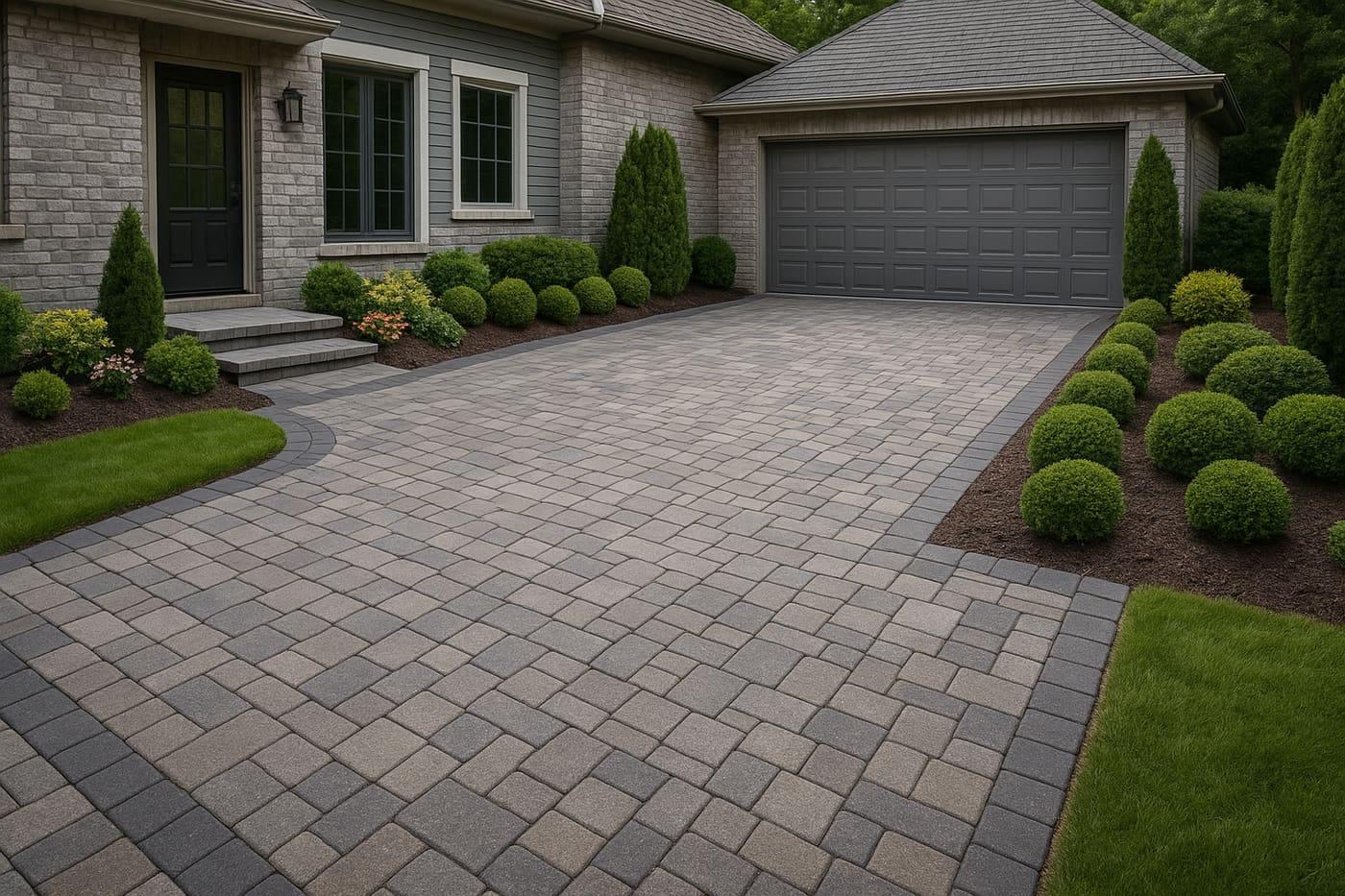
A driveway works harder than anything else on a residential lot. A loaded refuse truck puts more weight on one rear axle than everything else that touches the property in a year, and it does it on the same two wheel paths every week, usually when the ground is wet. That is the reason we do not build driveways out of 60 mm patio pavers on a patio base. Vehicle-rated work starts at 80 mm units over a base section two to three times deeper than what a patio needs.
Nearly every driveway failure we get called out to inspect is a base failure showing through the surface. Ruts tracking the tires, a settled dip right at the garage apron, edges creeping outward a half inch a year: those are all symptoms of thin rock, lifts placed too deep to compact, or a subgrade nobody proofed. On Alderwood till we typically dig 12 to 18 inches, roll the exposed subgrade with a loaded machine to find the soft spots, and bridge whatever pumps with quarry spalls and geogrid before any structural rock goes down.
The paperwork on a driveway is real, and it is where a lot of projects stall. Anything in the public right-of-way, which includes the apron and the curb cut, needs a permit, and Kent, Renton, Auburn, and Seattle each run their own review and inspection process. Replacing a drive also puts hard surface back onto the stormwater ledger once a project crosses local thresholds. We prepare those applications, and the same crew that laid out the drive is the one standing there when the inspector arrives.
What’s included
- Base section designed around the loads the drive will really see, including refuse trucks and delivery vans
- Demolition of the existing asphalt or concrete drive, with the material sent to a recycler
- Excavation to 12 to 18 inches and a proof-roll of the exposed subgrade under a loaded machine
- Quarry spall bridging lift anywhere the subgrade pumps, with biaxial geogrid over the worst areas
- Woven geotextile separation across the full footprint
- 80 mm vehicle-rated pavers set over a screeded one-inch angular chip bedding course
- Cast concrete toe restraint at every free edge instead of spike-in plastic
- Right-of-way and curb-cut permit coordination with the city, including the apron tie-in and inspection
- Heavy-duty trench drain at the garage door with a piped outfall wherever grade runs toward the house
Materials we use
- Mutual Materials 80 mm Holland Stone and Eco-Priora permeable pavers
- Techo-Bloc Industria and Aquastone units rated for vehicular use
- Belgard Holland Premier and Aqualine
- Basalite Aqua-Roc permeable paving units
- Crushed 1-1/4-inch minus and 5/8-inch minus base rock, plus 4-inch quarry spalls for bridging
- Tensar biaxial geogrid and Mirafi woven separation fabric
- ACO or NDS heavy-duty trench drain with ductile or cast grating
- Site-mixed 3,000 psi concrete for toe restraint and apron work
How the build runs
- Step 1
Load, access, and grade assessment
We look at what actually drives on it: a work truck, a trailer, an RV, the garbage truck that swings a wheel across the corner every week. Then we shoot grades from the crown of the street to the garage slab to see whether water is going to run at the house.
- Step 2
Permits, locates, and staging
Right-of-way and curb-cut applications go in early because review timelines vary by city. Washington 811 marks utilities, and side sewer and water service lines get located precisely, since both commonly run under a driveway at shallow depth.
- Step 3
Demolition and excavation
Old concrete or asphalt is broken out and hauled to a recycling yard. We excavate to design depth across the whole footprint, not just the wheel paths, and cut a clean vertical face at the edges so the base can be compacted right up against undisturbed soil.
- Step 4
Proof-roll and subgrade correction
A loaded machine is run over the open subgrade while someone watches for deflection and pumping. Soft areas get dug out and bridged with quarry spalls choked with finer rock, and geogrid goes over the worst of it. This step is skipped on most cheap driveways and it is why they rut.
- Step 5
Structural base in controlled lifts
Fabric, then crushed rock placed in four-inch lifts and compacted with a heavy vibratory roller or reversible plate. Moisture gets managed with a hose in summer and by waiting out the worst of the rain in winter, because rock that is too wet or too dry will not reach density.
- Step 6
Bedding, paver set, and cutting
One inch of angular chip is screeded, then 80 mm units go in on a laying pattern with real interlock. Herringbone at 45 or 90 degrees is what resists the twisting forces a turning tire applies, so that is what goes in the driving surface regardless of what the border does.
- Step 7
Restraint, jointing, and final inspection
Concrete toe is placed against every open edge and cured before traffic. Joints are filled and compacted, the apron is tied to the street to city standard, and we walk the finished drive with the inspector and with you before it takes its first vehicle.
A single-car drive of roughly 500 square feet usually runs four to six working days; a longer double drive with demolition, an apron rebuild, and a city inspection more often lands between seven and twelve, and we phase the work so there is somewhere to park most nights.
What it costs
Real installed ranges for the Puget Sound market, published so you can plan before anyone visits.
| Item | Typical range | Unit |
|---|---|---|
| Standard 80 mm paver driveway on a full base section | $28-$40 | per sq ft |
| Permeable paver driveway with open-graded reservoir baseDeeper excavation and washed stone drive the difference. | $38-$55 | per sq ft |
| Demolition and disposal of existing concrete or asphalt | $5-$11 | per sq ft |
| Subgrade correction with quarry spalls and geogrid | $9-$18 | per sq ft of corrected area |
| Right-of-way apron rebuild, poured or paverCity permit and inspection fees billed at cost on top. | $2,200-$6,500 | per apron |
| Heavy-duty trench drain at the garage with piped outfall | $120-$220 | per linear ft |
Treat these as typical installed ranges for driveways in the Puget Sound market, not as a bid; slope, machine access, how bad the subgrade turns out to be, and each city fee schedule change the total, and a site walkthrough is what produces the actual number.
Building this in the Pacific Northwest
Water trapped in the base is what breaks a driveway
Between 38 and 45 inches of rain falls on the Kent valley in a typical year, and more on the Covington and Maple Valley plateau. Water that gets into a base section and cannot leave turns a stiff rock layer into a saturated one that deforms under every axle load. We pitch the subgrade, not just the surface, and run a perforated edge drain in washed rock to daylight along the low side wherever the drive sits below surrounding grade.
Glacial till looks like a perfect subgrade and is not
Dense Alderwood till will hold a compactor beautifully in July and deflect under a loaded truck in January because the water sitting on the hardpan has nowhere to go. Proof-rolling is the only honest way to find that out. Quarry spall bridging and geogrid cost real money on the front end and cost far less than rebuilding a rutted driveway in year four.
Frequent shallow freeze-thaw and winter de-icers
Puget Sound lowlands cross the freezing line dozens of times a winter rather than freezing deep once. Repeated cycling on a saturated base causes small movements that a monolithic concrete slab answers with a crack, and that segmental pavers absorb by shifting slightly and reseating. Keep rock salt off any new concrete apron for its first winter, and use a calcium magnesium acetate de-icer on the paver field.
Right-of-way permits, width limits, and stormwater
The apron and curb cut belong to the city, and touching them requires a permit with a sight-distance review in most jurisdictions here. Cities in King County commonly cap residential driveway width at the property line somewhere in the 20 to 24 foot range, and the exact number is in the local development code. Replaced hard surface also counts toward the drainage review thresholds in the King County Surface Water Design Manual, which is one reason permeable paving keeps coming up on larger drives.
Driveways we have built
Recent driveways projects
Driveways: common questions
Are pavers actually strong enough for a driveway?
Yes, when the right unit sits on the right base. Interlocking concrete pavement is used for port container yards, bus lanes, and airport aprons because the interlock distributes a point load across many units. An 80 mm paver on a 12 to 18 inch compacted section handles residential traffic and refuse trucks without complaint. The failures people remember came from thin patio pavers on four inches of rock.
How do pavers compare to concrete and asphalt here?
Asphalt is cheapest and softens in summer heat, ravels at the edges, and wants a seal coat every few years. Concrete lasts longer and cracks on our freeze-thaw and root movement, with repairs that never match. Pavers cost more up front, flex instead of cracking, and let a settled area be lifted and reset with the original units. Over a twenty-year horizon the three end up much closer than the first invoice suggests.
What is a permeable driveway, and does it make sense in this climate?
Permeable pavers use open joints filled with small washed stone over a deep reservoir of open-graded rock, so rainfall infiltrates instead of running to the street. In King County that can offset stormwater requirements on a project that would otherwise trigger drainage review. It works best where the underlying soil drains. On tight till we design it as a detention-and-release system with an underdrain rather than pure infiltration.
Do I need a permit to replace my driveway?
For the portion on your own property, usually not, unless you are changing grade significantly or adding enough hard surface to trigger drainage review. For the apron, curb cut, and anything in the right-of-way, yes, in every city we work in. Widening a drive or relocating the curb cut also brings a sight-distance review. We handle the applications and the inspection scheduling as part of the job.
What happens if a spot settles a few years from now?
It gets fixed properly, which is the practical advantage of segmental paving. We pull the affected units by hand, keep them on a pallet, correct or recompact the base underneath, re-screed the bedding, and set the same pavers back. There is no color-matched patch and no saw line across the drive. A localized repair like that is typically a half day of work.
Will oil drips stain the pavers?
Fresh drips clean up with an absorbent and a degreaser made for concrete pavement. Old, soaked-in stains are harder, which is one more reason to keep a few square feet of leftover pavers on site: a stained unit can simply be swapped for a clean one. A penetrating sealer applied after the first year gives the surface a head start, though it does need renewal every three to five years.
Yard visualizer
Not sure what you want? Design it here in 30 seconds.
Upload a photo of your yard, pick a style, and see it rebuilt with the materials we actually install. Then we build it — same crew.