
Landscaping
Planting Design & Installation in Kent & Greater Seattle
Quick answer
Planting design is a drawn plan and installed plant palette matched to Zone 8b conditions: wet winters, dry Augusts and till subsoil. We draw the plan, then prep beds, plant and mulch. Typical Puget Sound bed installations run $18 to $45 per square foot depending on plant size and soil work.
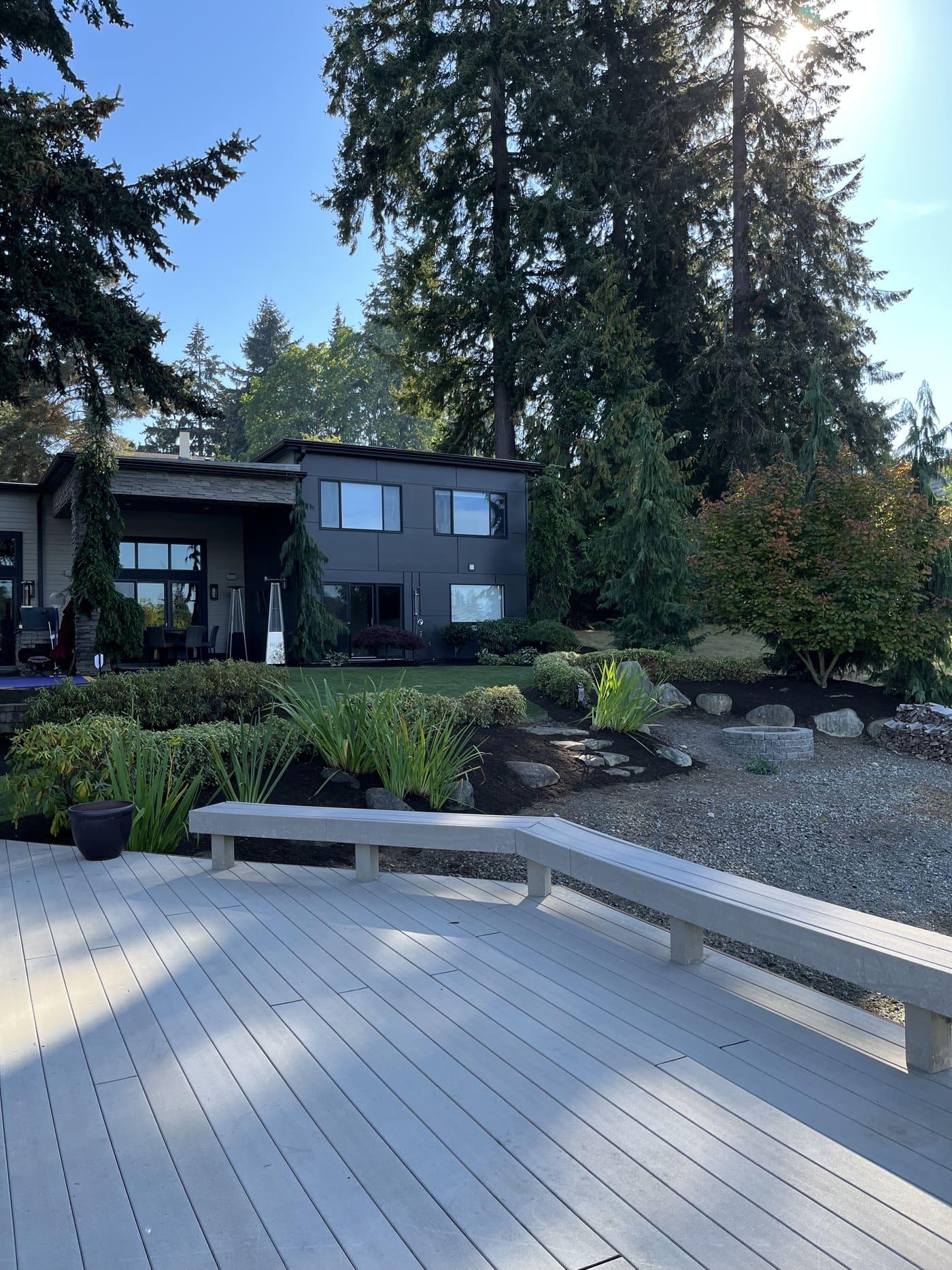
Plants die here for one reason far more often than any other, and it is not cold. It is a planting hole dug into cemented glacial till, backfilled with fluffy compost, that fills with water in November and holds it until March. The roots sit in that bathtub and drown. A rhododendron that looked fine all summer collapses the following spring and everyone blames the winter. Design in this region starts underground, with how a bed drains, and only then moves to what looks good next to the front door.
Sun and shade are mapped through the actual day on your lot, not assumed from a satellite photo, because a west-facing Kent East Hill bed and a north-side Ballard strip under a mature maple are two entirely different growing environments 20 miles apart. We put a scaled plan and a plant schedule in your hands, with mature sizes noted, so you know what the bed looks like in year seven rather than the week it goes in.
Zone 8b gives us an unusually long list to work from. Sword fern, salal and evergreen huckleberry hold the shaded structure through winter. Vine maple and Japanese maple carry the fall color and the branch pattern that matters in a January garden. Dwarf conifers give year-round mass without becoming a hedge you fight. Hydrangea, rhododendron and hebe do the flowering work, carex softens edges, red twig dogwood lights up the dormant months, and lavender earns its place only in the hottest, sharpest-draining spot you have.
The honest part of the conversation is what your site cannot support. Full sun Mediterranean planting on a flat lot in the Kent valley with silt soil is a slow failure no matter how good the design looks on paper. Deer in Maple Valley and Issaquah will strip a new hosta bed in one night. We would rather say that at the walkthrough, adjust the palette, and give you something that reads well in February than sell you a photo that looks great for one June.
What’s included
- Site read covering sun exposure through the day, existing tree canopy, drainage patterns and any wind-exposed edges
- Percolation check and soil assessment in each proposed bed, including how deep the till or hardpan sits
- Scaled planting plan with a plant schedule listing species, size at install and mature dimensions
- Bed shaping and edge definition, with beds cut to a line that a mower can follow cleanly
- Soil work across the entire bed rather than hole by hole, amending and decompacting to real rooting depth
- Plant sourcing from Puget Sound wholesale growers, with substitutions cleared with you before install day
- Layout of every pot on the ground for your walkthrough and approval before a single hole is dug
- Planting, staking where a tree needs it, and drip irrigation tied into a new or existing zone
- Mulch across the finished bed and a written establishment watering schedule for the first two summers
Materials we use
- Nursery stock from Puget Sound wholesale growers including T&L Nursery in Redmond and Monrovia-grown material
- Iseli Nursery dwarf conifers for year-round structure in small beds
- Cedar Grove compost and Pacific Topsoils three-way garden mix for bed building
- Coarse pumice and crushed basalt fines for sharpening drainage in lavender, hebe and rock-garden beds
- Arborist wood chips and medium fir bark for mulch, matched to the bed style
- Permaloc and Col-Met steel edging where a hard bed line is needed against turf
- Rain Bird XFS and Netafim pressure-compensating dripline with emitters set at the plants, not on a grid
- Mycorrhizal inoculant and slow-release organic starter fertilizer at planting
How the build runs
- Step 1
Read the site
We spend real time on the lot before drawing anything. Where the sun actually lands in July and in December, which roots are already claiming the bed, where water sheets during a downpour, how far down the shovel goes before it stops. A hole gets dug and filled with water in each major bed area to see how fast it drains, because that single test rules out or unlocks half the plant list.
- Step 2
Draw the plan
You get a scaled layout, a plant schedule with species and install sizes, and mature spread noted so nothing gets planted at a spacing that looks generous now and becomes a thicket in five years. We design for winter first. If the bed reads well in mid-January, it will look after itself in June.
- Step 3
Build the bed, not the hole
The crew strips sod and weeds, defines the bed edge, and works the soil across the whole footprint. Compost gets incorporated into the top eight to twelve inches rather than dumped into individual holes, and where hardpan sits close to the surface we either break through it or raise the bed above it. Digging a nice planting hole in till and filling it with amendment creates a sump.
- Step 4
Set the pots and walk it
Everything arrives and gets placed in position, still in the containers, spaced at mature dimensions. You walk it with us before we dig. This is the cheapest possible time to move a Japanese maple three feet left or decide the hydrangea should be a rhododendron, and it is the step that separates a bed you like from a bed you tolerate.
- Step 5
Plant it properly
Root balls get scored or teased apart, especially on anything container-bound, and every plant goes in with the root flare at or slightly above finished grade. Nothing is planted deep. Backfill is native soil blended with the amended bed, watered in to close voids rather than stomped, and trees are staked only when they genuinely need it and released after a season.
- Step 6
Irrigate and mulch
Dripline is run through the bed with emitters placed at each root ball rather than in a uniform grid, then covered by mulch. Two to three inches of arborist chips or fir bark goes down across the bed, pulled back off the stems and trunks so nothing sits in damp mulch all winter and rots at the collar.
- Step 7
Hand over the establishment plan
You get a written watering schedule for the first two summers, which is when new plantings actually live or die around here, plus notes on when each shrub should be pruned. Rhododendron after bloom. Lavender never into old wood. We follow up after the first dry stretch to see how the bed is holding.
A planting plan takes 1 to 2 weeks to draw and revise; installation of a single front-yard bed is typically 1 to 2 crew days, a full front-and-side planting refresh runs 3 to 5 days, and a whole-property planting scheme with soil imports and drip irrigation takes 1 to 2 weeks.
What it costs
Real installed ranges for the Puget Sound market, published so you can plan before anyone visits.
| Item | Typical range | Unit |
|---|---|---|
| Planting plan and plant schedule, drawn in houseCredited toward the install when we build the plan | $650-$2,600 | per plan |
| Installed planting bed, plants plus soil prep and mulch | $18-$45 | per sq ft |
| Shrub installed, 2 to 5 gallon | $70-$185 | each |
| Tree installed, 6 to 10 ft or 15 gallonLarger specimen trees requiring machine placement price higher | $450-$1,300 | each |
| Bed soil work: compost, amendment and decompaction | $4.00-$8.50 | per sq ft |
| Mulch refresh, arborist chips or fir bark | $95-$155 | per cubic yard installed |
These are typical installed ranges for the Puget Sound market in 2026 and not a quote, because plant size, how far material has to be carried, and how much soil work a bed actually needs change the total more than the plant list does, all of which we pin down at the site walkthrough.
Building this in the Pacific Northwest
Winter drowning kills more plants here than cold
From November through March the top foot of soil across most of King County stays at or near saturation, and roots in standing water suffocate long before they freeze. Phytophthora root rot follows, which is why rhododendron and Japanese maple planted in a low spot fail in their second or third spring. We plant on slightly raised grade, amend the full bed so water can move laterally, and route surface water away before installing anything. Lavender, hebe and rock-garden material only go into mounded, gritty, sharply drained beds.
Alderwood soils and the hardpan ceiling
Alderwood and Everett series soils cover most of the East Hill, Covington and the Renton plateau: a shallow gravelly loam over cemented glacial till that a shovel simply stops at, often 18 to 30 inches down. Roots cannot penetrate it and neither can winter water, which perches on top and floods the root zone. Effective rooting depth, not the plant tag, sets what will grow. We either break the till mechanically, build the bed up above it, or select shallow-rooted natives like salal, sword fern and kinnikinnick that are adapted to exactly that profile.
The dry August nobody plans for
Puget Sound reads as a rainy climate and then delivers six to eight weeks with essentially no measurable rain most summers, while foothill-edge properties toward Maple Valley and Issaquah take four to six feet of rain the rest of the year. New plantings need real supplemental water through their first two summers regardless of how drought-tolerant the species is at maturity. We install dripline on new beds as a default and hand over a watering schedule, because an established sword fern needs nothing and a first-year one dies without help.
Permits, protected trees and critical area buffers
Planting a bed needs no permit. Three things around it can. Most South King County cities regulate removal of significant trees over a certain diameter and require a permit or replacement planting, so we check before anything comes down. Street trees in the right-of-way generally need approval and a species from the city list. Parcels inside a mapped wetland, stream or steep-slope buffer are often restricted to native plantings from an approved list, and we design to that list rather than gambling on an after-the-fact correction.
Planting & Design we have built
Recent planting & design projects
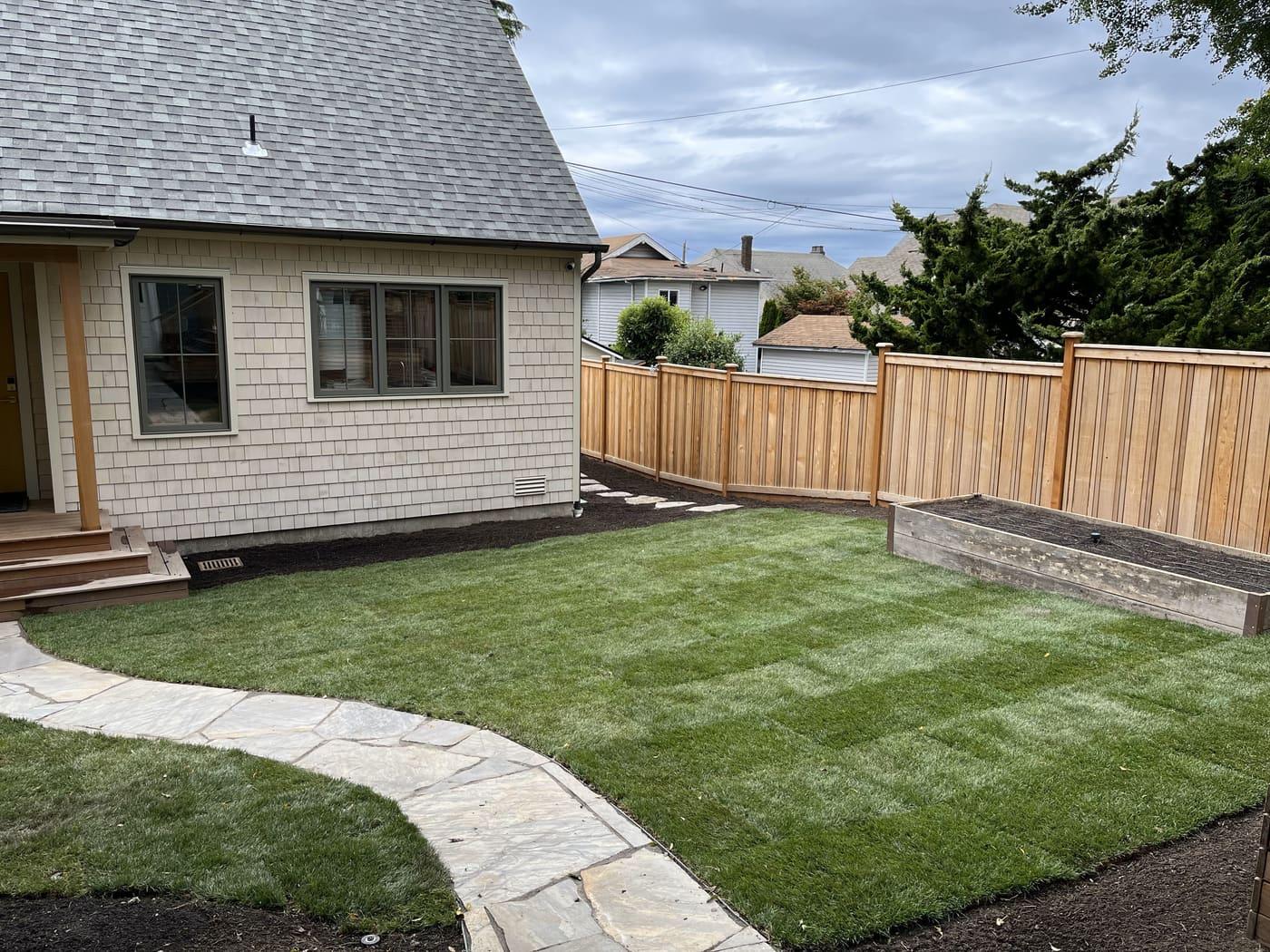
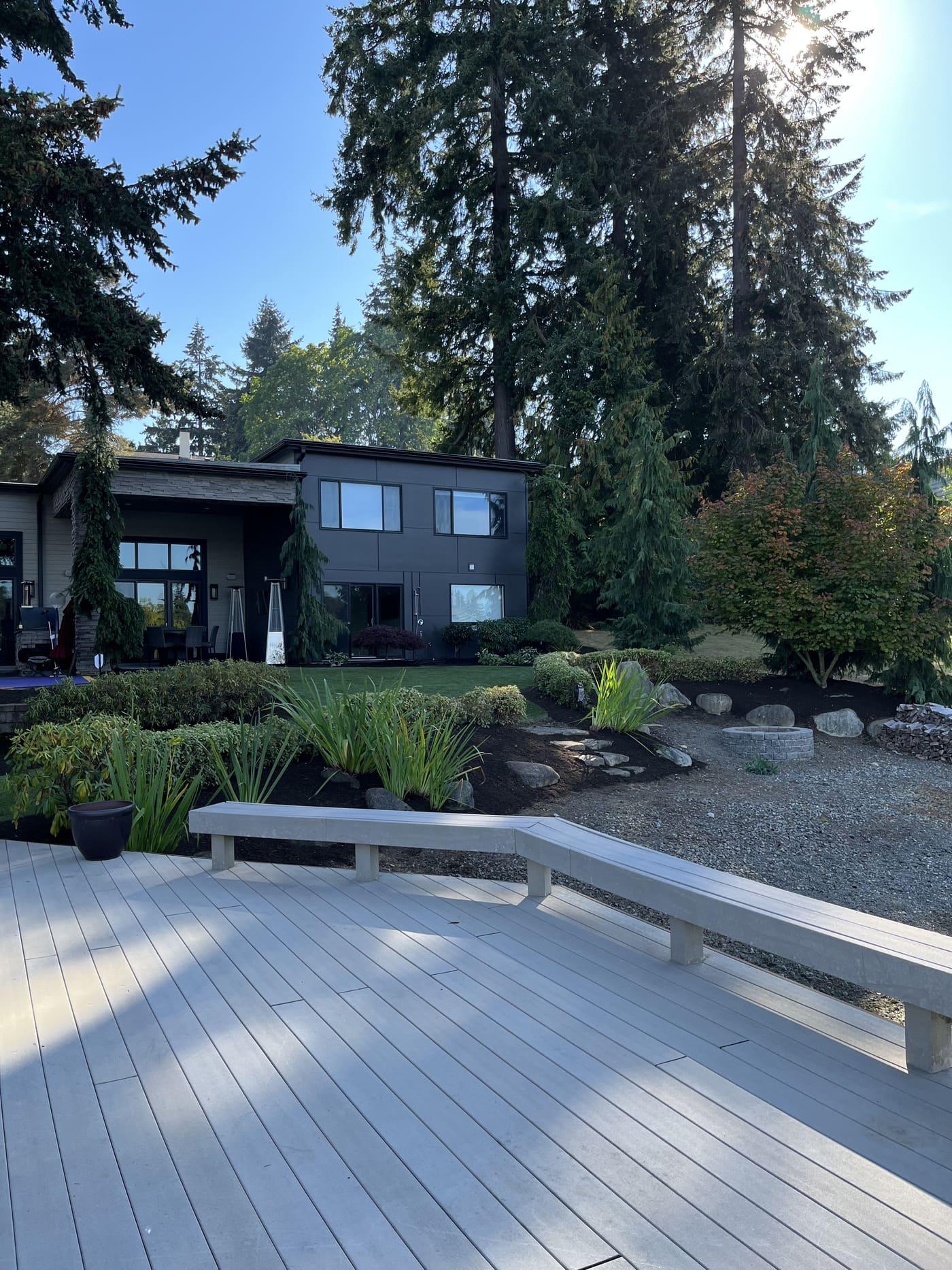
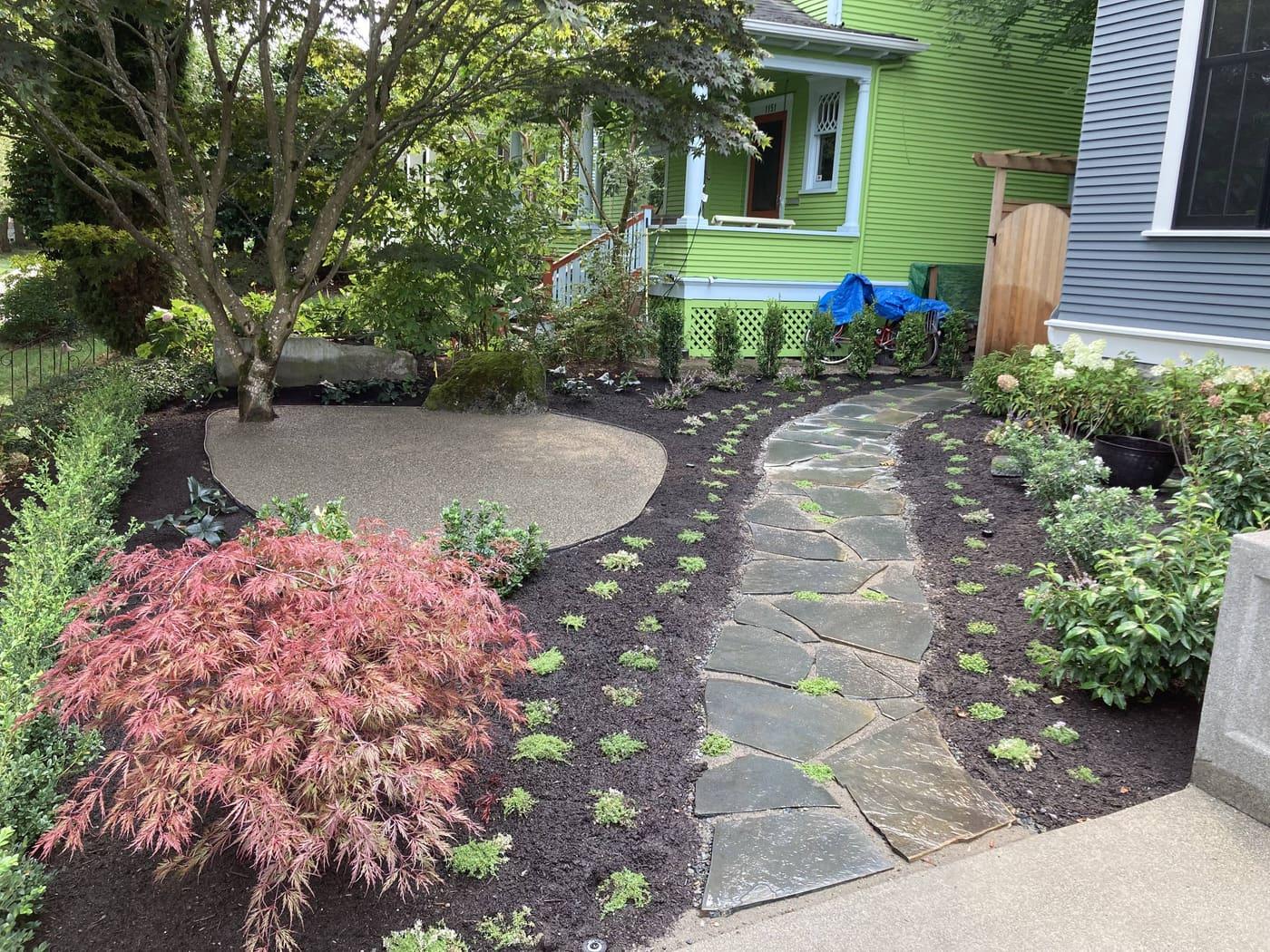
Planting & Design: common questions
What actually thrives in a soggy Kent yard?
Plants adapted to seasonally wet ground. Red twig dogwood is the obvious one and gives you winter stem color as a bonus. Sword fern, salal, carex sedges and evergreen huckleberry handle wet winters as long as they are not fully submerged. Vine maple tolerates a damp edge well. What will not survive it is lavender, most Mediterranean material and anything with a tag reading well-drained soil required.
When is the best time of year to plant in western Washington?
October and November are the best window by a wide margin. Soil is still warm, the rains have returned, and plants spend the whole cool season putting out roots before their first summer. March and April are a solid second choice. Planting in July is possible but commits you to hand watering through the hottest weeks, and we generally steer clients away from it.
Do you use landscape fabric under the mulch?
Almost never in a planted bed. Fabric stops nothing after two seasons, because weeds germinate in the mulch layer above it, and meanwhile it blocks the organic matter that should be building your soil and makes future planting a chore of cutting Xs in plastic. We use depth of mulch, correct plant spacing and honest weeding instead. Fabric has a place under gravel paths, not under shrubs.
How much watering does a new planting need?
Deep and infrequent beats daily sprinkles. Through the first summer, plan on a long soak two or three times a week during dry weeks, enough to wet the full root ball and a few inches beyond. Second summer you can back off to weekly. By the third year, a well-chosen Zone 8b palette should carry itself through August with occasional help. Drip irrigation on a timer takes the guesswork out.
Can you design something deer will leave alone?
We can shift the odds substantially, though nothing is truly deer-proof in a hard winter. In Maple Valley, Issaquah and Sammamish we lean on plants deer generally pass over: lavender, hebe, most ferns, ornamental grasses and carex, salal, kinnikinnick and dwarf conifers. Things to avoid include hosta, tulip and young arborvitae. New plantings of anything get the most pressure in their first year while they are tender.
Can I get just the plan and install it myself?
Yes. We produce standalone planting plans with a scaled layout, a full plant schedule with sizes and quantities, spacing, and notes on soil prep and establishment watering. Plenty of clients build it themselves over a couple of weekends or phase it across two seasons. If you later decide you want us to install it, the plan fee is credited toward the work.