
Landscaping
Sod Installation in Kent & Greater Seattle
Quick answer
Sod installation replaces a lawn with mature turf instead of seed: old turf comes out, the subgrade gets repaired, four to six inches of amended topsoil goes down, and the sod is laid within a day of harvest. Installed cost across Puget Sound typically runs $2.20 to $4.00 per square foot over prepared soil.
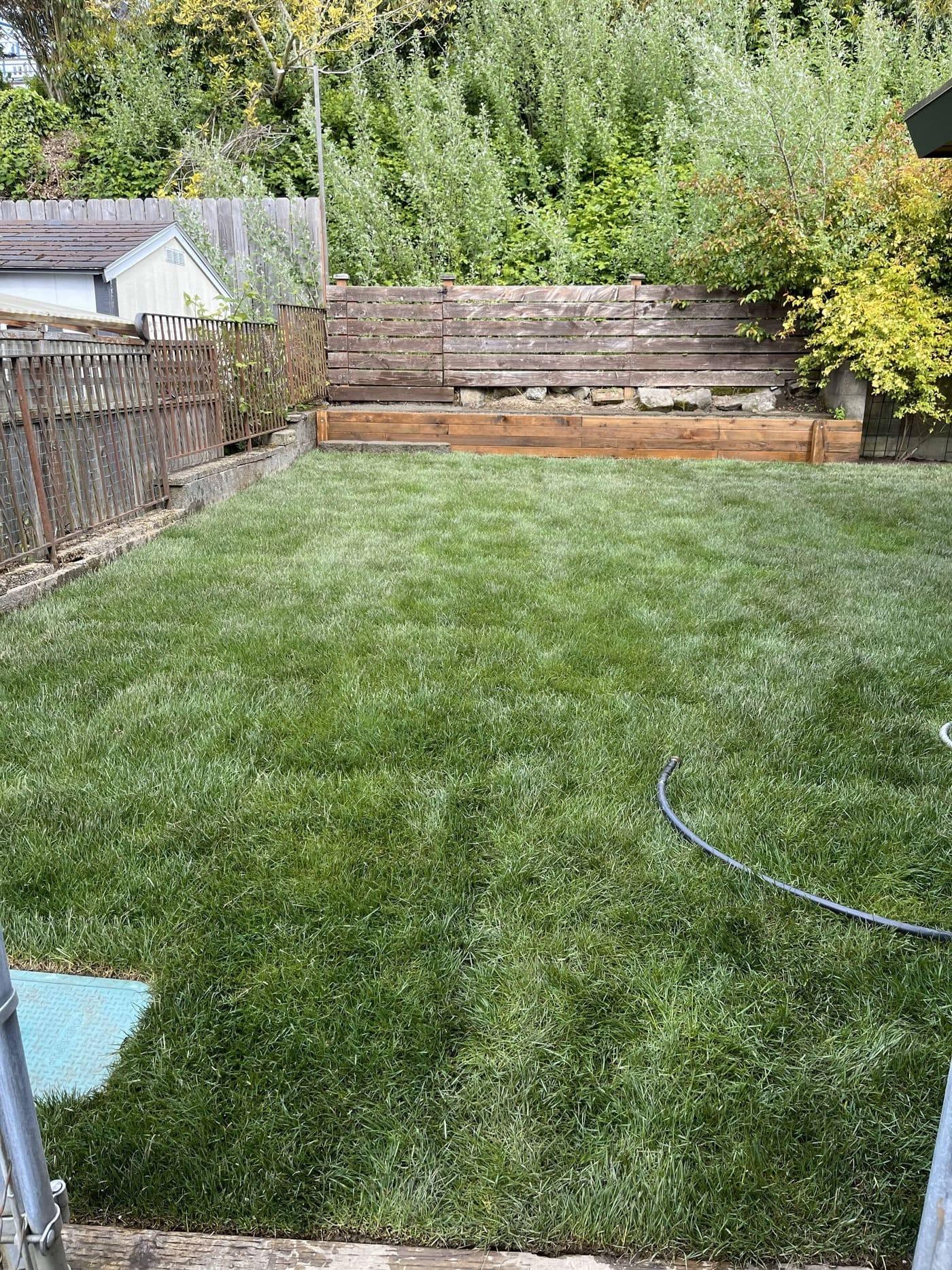
Sod is the easy part. Two people can lay 2,000 square feet of turf in a morning and it looks finished before lunch. Everything that determines whether that lawn is still good in three years happens before the first roll comes off the pallet: what the subgrade is doing, how deep the growing medium is, and whether water has somewhere to go in February. Green carpet rolled over compacted fill with two inches of soil under it is a lawn with an expiration date, and we see those get replaced constantly across South King County.
Our standard is four to six inches of screened sandy loam over a scarified, decompacted subgrade. That depth is what lets roots go down instead of running sideways along a hard layer, and it is what carries a lawn through an August dry spell without going crisp in ten days. On the Kent East Hill and up on the Renton plateau, that usually means ripping the top of the till so the new soil is not sitting on a lid. Down on the valley floor it more often means correcting a grade that puts water against the house.
Turf comes off Puget Sound farms in Sumner and Puyallup, cut to order and delivered the morning we lay it. That timing is not a preference. Sod is a living crop with roughly a 24-hour window in warm weather before the rolls start heating on the pallet and the grass yellows in the middle. So we finish grade the day before, book the delivery for first thing, and the pallets are empty by the end of that day. Our own crew grades, lays and rolls it, start to finish.
What’s included
- Removal of existing turf, weeds and roots by sod cutter or machine, with all material hauled off site
- Subgrade evaluation, scarifying and decompaction so the new soil layer bonds instead of perching on a hard pan
- Correction of drainage problems found during excavation, including French drains or regrading where needed
- Import, delivery and spreading of screened sandy loam topsoil to a consistent 4 to 6 inch depth
- Compost and starter fertilizer incorporated into the growing layer, with lime where soil pH calls for it
- Final grading pitched away from foundations, patios and walkways, then rolled and hand-raked to a smooth plane
- Fresh-cut sod delivered from a Puget Sound farm and laid in a staggered brick pattern with tight seams
- Perimeter and interior cuts fitted to beds, sprinkler heads, trees and hardscape edges
- Rolling to press roots into soil contact, a first deep watering, and a written 30-day watering and first-mow plan
Materials we use
- Locally grown perennial ryegrass, fine fescue and Kentucky bluegrass blend sod from Sumner and Puyallup turf farms
- Shade-tolerant fine fescue blend sod for north-facing yards and areas under conifer canopy
- Pacific Topsoils screened sandy loam and three-way garden mix as the growing layer
- Cedar Grove compost incorporated into the top few inches of the soil profile
- Starter fertilizer in a phosphorus-forward analysis such as 12-24-12, plus dolomitic lime for pH correction
- Perforated pipe, filter fabric and clean drain rock for French drains and low-spot correction
- Water-filled turf roller and sod cutter, plus a laser or transit for setting the final grade
How the build runs
- Step 1
Find out why the old lawn failed
Before quoting a replacement we figure out what killed the last one. Shade from a maple that has doubled in size. A downspout dumping at the low corner. Fill dirt from the original build compacted to the density of a driveway. Moss over a pH of 5.2. Replacing turf without fixing the cause buys you two good seasons and the same conversation again, so this walkthrough shapes the whole scope.
- Step 2
Strip and haul the existing lawn
A sod cutter takes the old turf and its thatch layer off in strips, and on rough or weed-choked ground we take it out with a machine instead. Everything leaves the property. We do not till old grass under, because perennial ryegrass and quackgrass come straight back through new sod and buried thatch creates a soft layer the new roots will not cross.
- Step 3
Fix the subgrade and the water
With the surface off, the real condition shows. Compacted subgrade gets ripped or scarified so the new soil ties in. Low pockets that hold water get drained, usually with perforated pipe in drain rock running to daylight or a drywell. Grade is reset to fall away from the house and any hardscape at a workable slope. This step is invisible in photos and is the reason the lawn lives.
- Step 4
Import and blend the growing layer
Screened sandy loam is brought in and spread to a uniform 4 to 6 inches, with compost worked into the upper portion and starter fertilizer and lime broadcast in. On heavy sites we go deeper. The blend matters more than the brand: turf wants a medium that drains through a wet December and still holds moisture in the third week of August.
- Step 5
Fine grade and roll
Final grade is set with a rake and a light roll to firm the surface without compacting it, and we check the plane by eye and by string. Grade is held about an inch below adjacent walkways, patios and driveways so the finished sod sits flush with the concrete instead of an inch above it. Sprinkler heads are set to final height at this point.
- Step 6
Lay, cut and roll the sod
Rolls are laid in a staggered brick pattern with seams butted tight, never overlapped and never stretched, working off boards so nobody prints the fresh grade. Slopes run perpendicular to the fall and get staked where needed. Perimeter pieces are cut in around beds and heads. Then the whole lawn is rolled to press roots into soil contact and immediately watered deep.
- Step 7
Hand over the first month
The first 30 days decide it. We leave a written schedule: heavy daily water for the first week or two, then tapering to deeper and less frequent as the roots take. Stay off it until it stops lifting at the corner. First mow at around 10 to 14 days, one third of the blade, sharp blades, dry surface.
A 2,000 sq ft replacement lawn with tear-out, imported soil and sod typically takes 2 to 3 crew days; 5,000 sq ft or any yard needing drainage correction runs 4 to 6 days, and we schedule the sod delivery for the morning after final grade so it goes down within a day of being cut.
What it costs
Real installed ranges for the Puget Sound market, published so you can plan before anyone visits.
| Item | Typical range | Unit |
|---|---|---|
| Sod supplied and installed over soil we have already prepared | $2.20-$4.00 | per sq ft |
| Complete new lawn: tear-out, grading, imported soil and sodThe most common scope on a full lawn replacement | $3.75-$7.00 | per sq ft |
| Existing lawn removal and haul-off | $0.90-$2.10 | per sq ft |
| Imported screened sandy loam, delivered and spreadRoughly 15 cubic yards per 1,000 sq ft at 4 to 6 inches deep | $65-$110 | per cubic yard |
| French drain in a chronically wet lawn area | $38-$75 | per linear foot |
| Machine rough grading and slope correction | $1.10-$2.75 | per sq ft |
The numbers above are typical installed ranges for the Puget Sound market in 2026, not a quote, since gate width and machine access, how much old material has to leave, soil import depth and whether the yard needs drainage work swing the total considerably, and a walkthrough is what produces the real figure.
Building this in the Pacific Northwest
Drainage decides whether the lawn survives its first winter
A lawn is the lowest, flattest surface on most lots, so it collects everything the roof, driveway and slope send its way. Turf sitting in standing water for weeks goes anaerobic, roots rot, and moss takes the ground by February. Before any soil is imported we find out where water arrives and where it can leave. That may mean a French drain to daylight, a catch basin at a persistent low spot, redirecting a downspout that has been discharging into the middle of the yard, or simply resetting the grade to a consistent fall away from the house.
You are usually building on till or on fill
Uphill in Kent, Covington and the Renton plateau, Alderwood series soil sits on cemented glacial till that stops a shovel and stops water. Down on the valley floor toward Tukwila and the Green River, lots are frequently deep silt or builder fill compacted hard during construction. Both produce the same failure: roots hit a barrier a few inches down, run sideways, and cook the first hot week of August. Ripping the subgrade before importing soil is what breaks that cycle, and it is the step most cheap sod jobs skip.
Timing the install around our weather
Mid-September to late October is the best window in this region by a clear margin, with March through May close behind. Soil is warm, rain is doing the watering, and roots knit in before any stress arrives. Sod will establish in July, but only with irrigation already running and a serious daily commitment. Laying in a hard December freeze is the one thing we will not do: sod does not root into frozen ground, and rolls left on a pallet through a cold snap come apart at the seams.
Grading permits and what actually triggers one
Laying sod requires no permit. Moving dirt can. King County and its cities set clearing and grading thresholds by volume and area, and a straightforward lawn replacement with a few truckloads of topsoil normally stays under them, while a project reshaping a slope, importing large volumes or working inside a mapped wetland, stream or steep-slope buffer will need review. Thresholds are not identical between Kent, Auburn and unincorporated King County, so we check the code for your parcel before scheduling a machine.
Sod Installation we have built
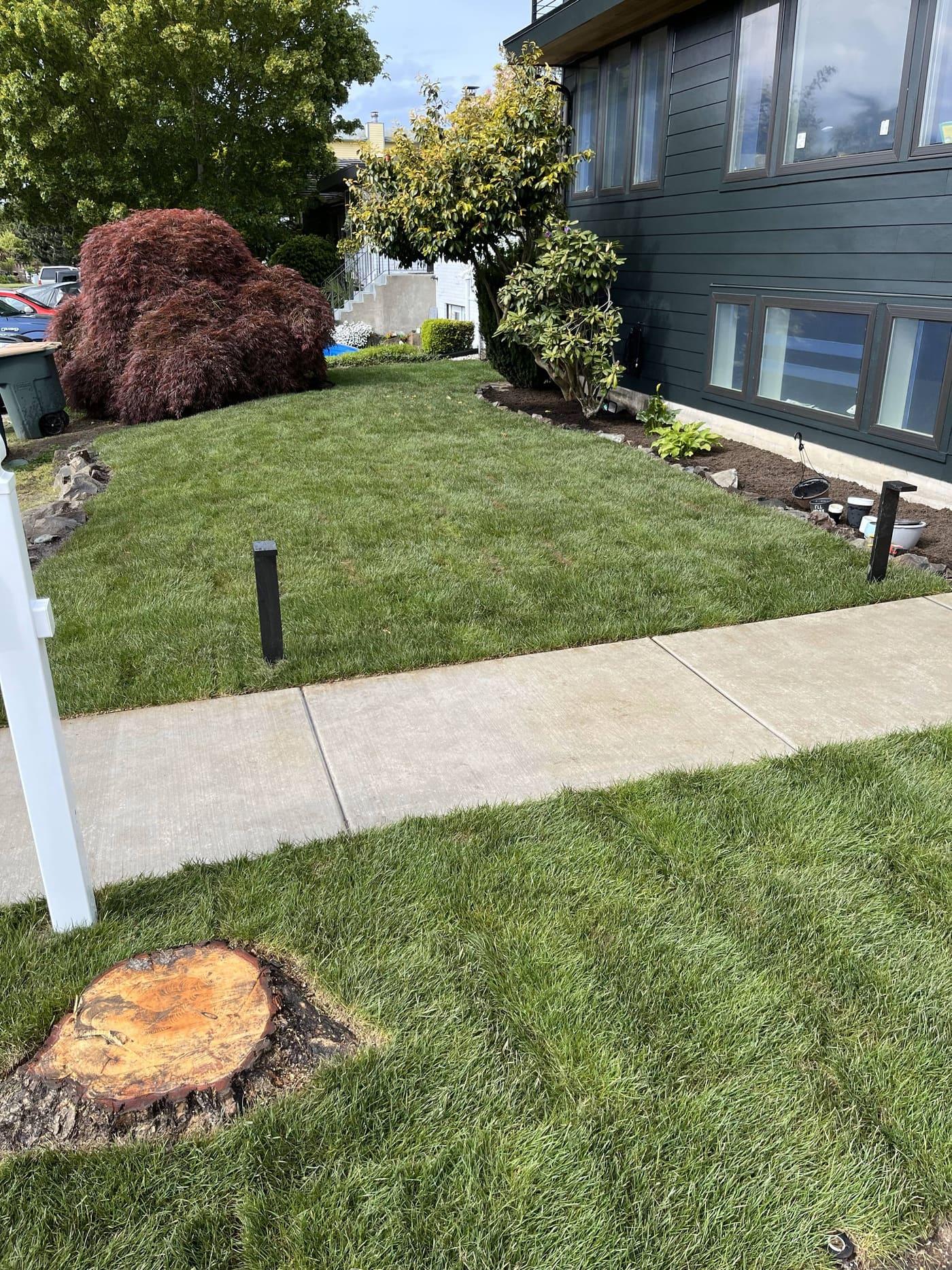
Recent sod installation projects
Sod Installation: common questions
How much do I water new sod, and for how long?
Heavy at first, then progressively less. For the first 10 to 14 days keep the soil beneath the sod continuously moist, which in summer usually means watering two or three times daily in short cycles. Weeks three and four drop to once a day, then to deep soakings two or three times a week. Lift a corner: if the soil under it is dry, you are behind.
When can I walk on it and mow it?
Keep foot traffic off for the first two weeks beyond what watering requires, and keep pets and kids off entirely. Test rooting by tugging a corner around day 10; if it resists, roots have taken. First mow is typically 10 to 14 days in, on a dry surface with sharp blades, removing no more than a third of the blade height. Do not roll a heavy mower over saturated new sod.
Is sod better than seed in this climate?
Sod gives you an instant, weed-free, erosion-proof lawn and can go down in almost any month with workable weather. Seed costs roughly a third as much but needs a tight window, six to ten weeks of protection and constant moisture, and it loses to weeds on disturbed ground. For a front yard, a slope or anywhere with dogs and kids, sod is usually worth the premium. For a large back acre with time to spare, seed makes sense.
Will new sod fix my moss problem?
Only if the install fixes what caused the moss. Moss shows up where soil is acidic, compacted and shaded, and fresh turf laid over those same conditions is moss habitat again within two seasons. A real fix means liming to raise pH, ripping the compacted layer, importing a proper growing medium, and being realistic about deep shade. Under a mature conifer, a planted bed of sword fern and salal beats any lawn.
How long until the lawn is fully established?
Surface roots knit into the soil in about two weeks, which is when it stops lifting and takes its first mow. Deeper anchoring roots take six to eight weeks in good conditions. Full maturity, meaning it can handle regular traffic and shrug off a dry stretch, is roughly one growing season. A lawn installed in October is genuinely established by the following spring.
What kind of sod do you use?
A blend rather than a single species, which is what performs in the maritime Northwest. Standard is a perennial ryegrass, fine fescue and Kentucky bluegrass mix grown on Puget Sound farms in Sumner and Puyallup, cut to order and delivered the morning of install. For north-facing yards or areas under tree canopy we switch to a fescue-heavy shade blend, which tolerates lower light and needs less water.